StruXure, Azenco, and Renson all build capable motorized louvered pergola systems — this is not a page that pretends otherwise. The honest comparison is not between brands. It is between two ways of buying: a catalog product configured from a spec sheet and installed by a dealer, or a structure designed and engineered for your specific site by the company that builds the whole environment around it.
A well-made production shoe and a bespoke last are both shoes — only one was shaped to your foot. Motorized pergolas work the same way. A dealer-installed system is a manufactured product: engineered to standard configurations, selected from a catalog, and placed onto your property by an authorized installer. That model is legitimate, and for a straightforward rectangular patio it can serve well. The Allscape Patio Signature Series is the other model: a proprietary, spec-upgraded motorized louvered-roof system that exists only inside an Allscape design-build project. It is not resold as a product, because the structure is designed with the patio, the pool, the grade, the drainage, and the architecture of the home — then engineered for the specific loads your site will actually see. The comparison below is honest about what each approach does well.
StruXure is the most established U.S. brand, strong on smart-home automation, accessories, and a large dealer ecosystem. Azenco is respected for weather sealing and certification — its systems carry Miami-Dade wind approvals and watertight louver design. Renson is the European design-forward option, favored where minimalist architecture leads. Public comparisons consistently note the same caveat for all three: the installed result depends heavily on the local dealer's quality, the site preparation, and how well the standard product fits a non-standard property. Installed pricing for dealer systems is commonly reported in the range of $150–$200 per square foot, with typical projects running $35,000–$75,000 or more once screens, heaters, electrical, footings, and permits are included.
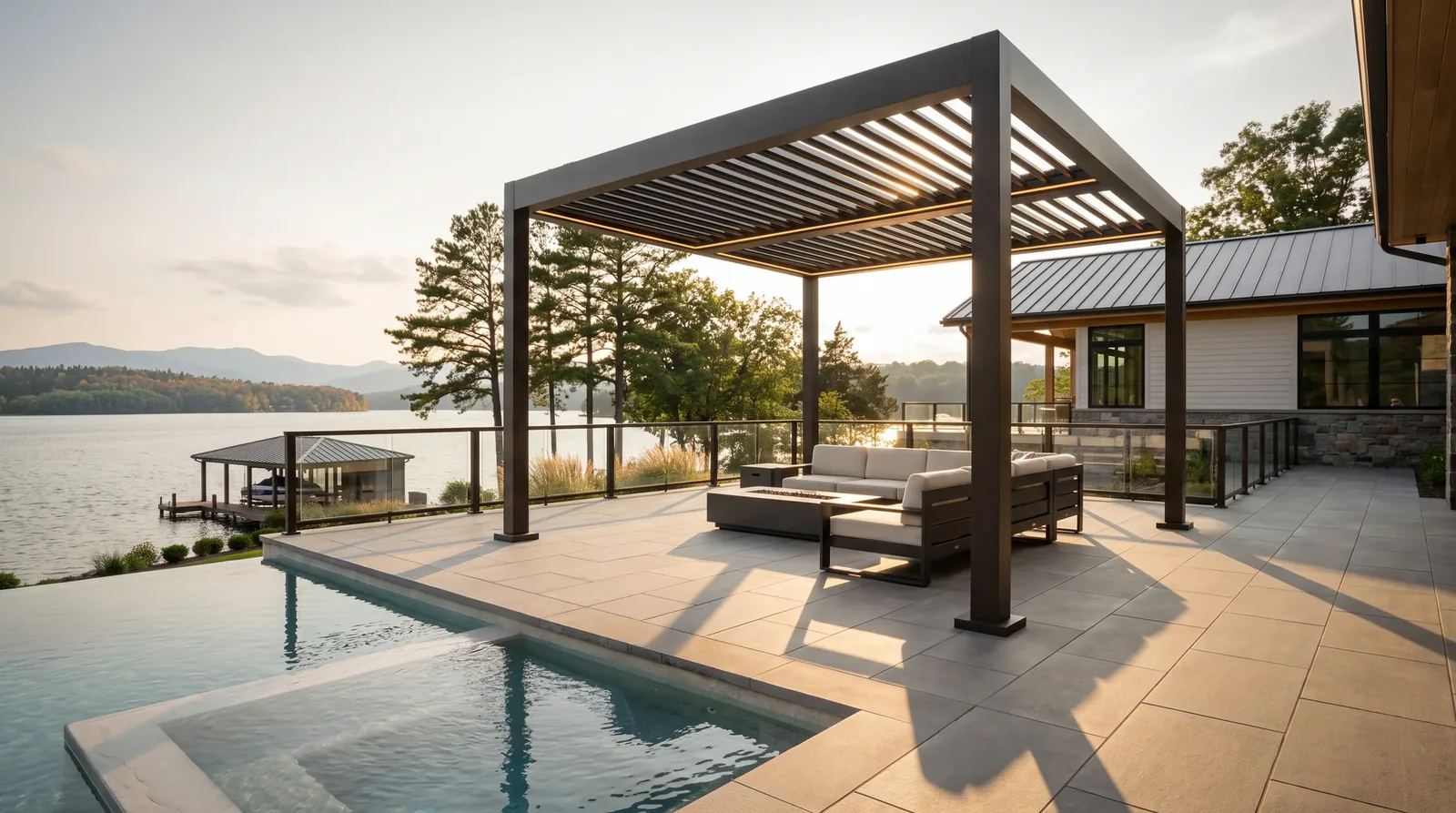
Catalog systems are engineered to standard load ratings, and owner reviews note the practical edges of that: caution in heavy snow, wind noise on exposed sites, and installations whose quality varies with the dealer. A design-build structure starts from the site instead. In Northeast Ohio, that means members and footings sized for lake-effect snow loads and a 32-inch frost depth. On the Carolina coast, it means fastener and finish specifications for 130–150 mph wind zones and salt air. Over a pool, it means footings placed outside the pool shell's backfill zone, equipotential bonding under NEC Article 680, marine-grade coatings for chloraminated air, and louver drainage routed away from the water. None of that comes from a catalog page — it comes from engineering the structure, the hardscape, the electrical, and the water as one project. That is the difference you are buying.
Every motorized pergola purchase falls into one of three models. Knowing which one you're in explains most of the price and quality differences you'll encounter.
Modular aluminum kits, self-installed or contractor-assembled, commonly $5,000–$12,000. Real shade and louvers at a real price — with standard sizing, lighter engineering, and no workmanship warranty behind the assembly.
StruXure, Azenco, Renson and similar systems, configured from the catalog and installed by an authorized dealer — commonly $35,000–$75,000+ installed. Strong products; the result depends on the dealer, and the structure is standard even when your site is not.
The structure is engineered for your site's loads and designed with the patio, pool, and home — priced by the complete project rather than the square foot. The Allscape Signature Series is this model: one company, one design, one warranty.
Signature Series motorized pergolas and complete outdoor living environments are designed and built across Northeast Ohio and Canton/Akron, the Columbus metro, Charlotte and Fort Mill, Myrtle Beach and the Grand Strand, and Virginia's Rocky Mount, Smith Mountain Lake, and Roanoke region — each installation engineered for its region's snow, wind, or coastal conditions. Figures cited on this page reflect public 2026 sources and are updated as the market moves.
